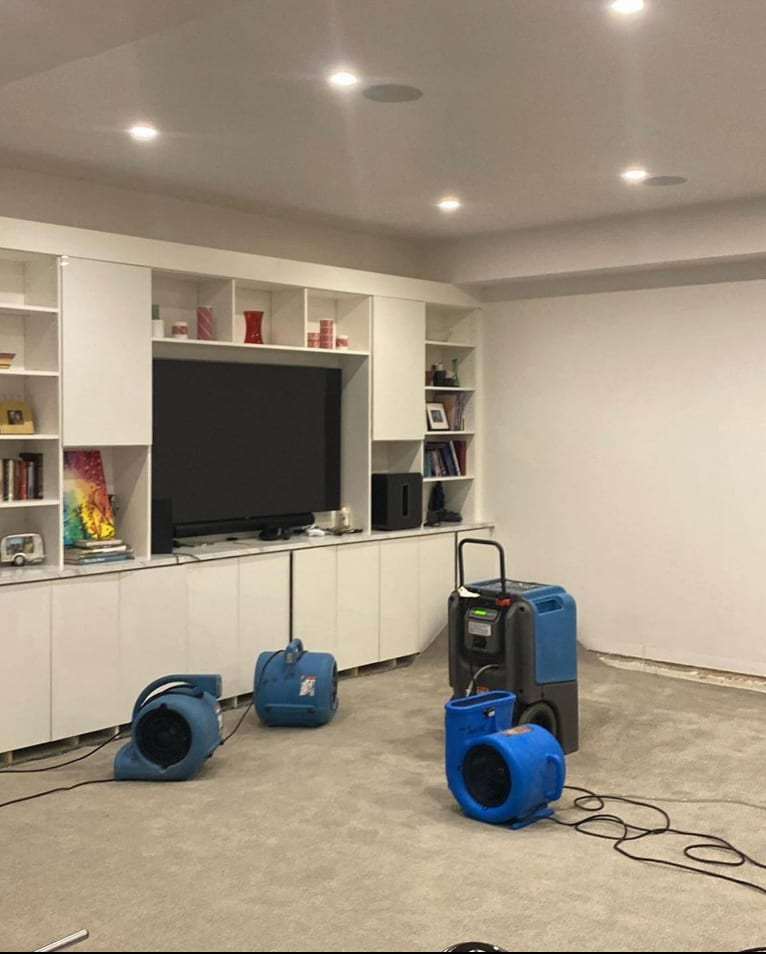
Living room carpet drying with air movers and a dehumidifier. Shown to illustrate the work described; not a job for this site or at any address named here.
A basement's remodel history, written in its walls
Basements near the park have been reworked by each generation of owners. A common sequence: the original brick or stone foundation was painted or whitewashed; mid-century owners nailed wood furring strips to it and hung paneling; later owners covered the paneling with drywall rather than remove it; and the most recent remodel may have added foam board or fiberglass batts in a new stud wall in front of all of that.
When water reaches the floor of a wall like this, it wicks into every layer. Drywall soaks it up quickly. Paneling, especially pressed wood product, swells and holds moisture. Furring strips sit tight against masonry that may itself be damp. Fiberglass insulation in a stud wall slumps and stays wet. The visible surface may dry within a day or two while the hidden layers stay wet for weeks, which is how odors and mold growth start long after the floor looked fine.
What you might find behind the surface
- Furring strips
- Thin wood strips fastened to masonry to give paneling or drywall something to attach to. They trap moisture against the foundation.
- Pressed-wood paneling
- Hardboard or particleboard panels with a printed veneer. They swell and delaminate when wet and rarely recover.
- Solid wood paneling
- Tongue-and-groove boards. These can sometimes be removed, dried and reinstalled if the water was clean.
- Foam board
- Rigid insulation glued or fastened to the foundation. It does not absorb much water but can hide moisture behind it.
- Flood cut
- Removing a horizontal band of wall material above the wet line so the cavity can dry.
- Moisture mapping
- Taking readings across a wall at intervals to find where water went, rather than relying on what looks wet.
A sensible way to open and dry a layered wall
Read before cutting
Moisture readings at several heights show how far water traveled. Non-invasive meters read the surface layer; probes reach deeper.
Open one test section
Remove a small piece of the outer layer to see what is behind it. This avoids cutting a whole room only to find solid masonry.
Remove layers that cannot dry
Pressed paneling, wet batts and soaked furring usually come out. Clean-water losses may allow solid wood to stay.
Dry the masonry
Old brick and stone release moisture slowly. Dehumidifiers and airflow on the exposed wall, with readings over several days, show when it has stabilized.
Decide how to rebuild
This is a chance to rebuild with fewer layers and moisture-tolerant materials rather than reinstalling the old sandwich.
General information for Washington Park, not a quote or professional advice. In an emergency, call 911.