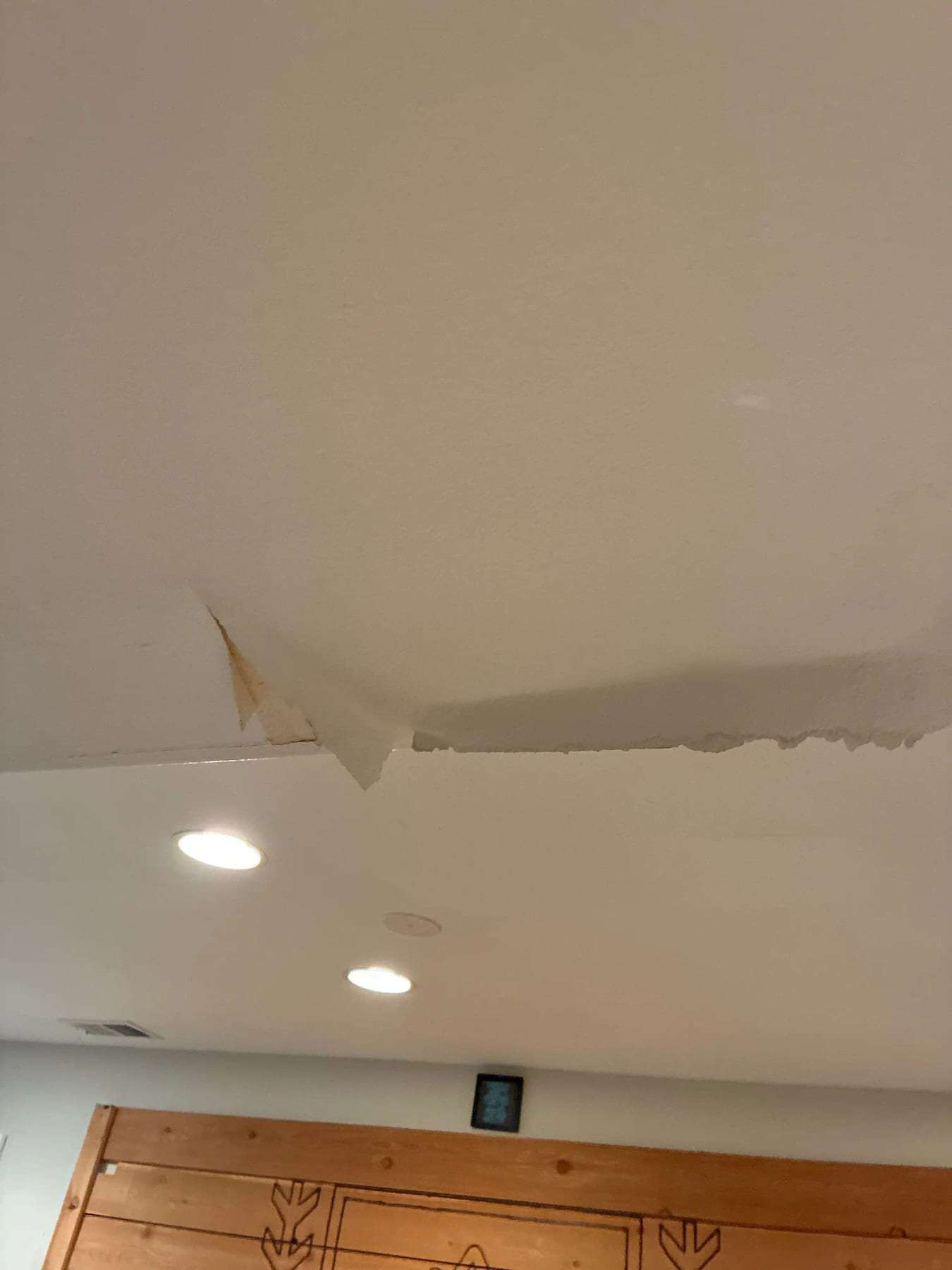
Ceiling drywall sagging and peeling after water came through. Example of the work involved; the photo does not show a specific property or a job for this site.
How water moves through a Denver Square
Denver Squares from the 1890s through the 1920s typically have a compact footprint, a central stair, and a second floor with bedrooms around a single bathroom. That bathroom often sits over the kitchen, the dining room or the back hall. Its floor was originally built with wood planks on joists, sometimes with a mortar bed under the tile, and plumbing that has been replaced piece by piece over a century.
Water from a failed tub drain, a wax ring, or a cracked supply line soaks the subfloor, then runs along joists until it finds a low point or a gap. It can travel several feet before dripping onto the back of the plaster ceiling below. Plaster on wood lath absorbs and holds water, so the first sign may be a faint yellow stain, then a bubble in the paint, then a sag.
Some of these houses also have balloon framing in the outside walls, where studs run continuously from foundation to roof. Water that gets into a wall cavity there can drop all the way to the basement, which is one reason a bathroom leak sometimes shows up as a damp spot on a basement wall.
Matching the symptom to a likely source
- Symptom below
- Stain grows after showers only
- Likely upstairs source
- Tub or shower drain, or failed grout and caulk
- Quick check
- Run the shower with the drain open, then closed, and watch
- Symptom below
- Stain grows after flushing
- Likely upstairs source
- Toilet wax ring or flange
- Quick check
- Look for rocking or staining at the toilet base
- Symptom below
- Stain grows all the time
- Likely upstairs source
- Supply line under pressure
- Quick check
- Watch the water meter with all fixtures off
- Symptom below
- Water appears near an outside wall
- Likely upstairs source
- Leak traveling in a wall cavity, or a roof or window issue
- Quick check
- Check for staining inside the bathroom walls
- Symptom below
- Damp spot in the basement under the bathroom wall
- Likely upstairs source
- Water dropping through a balloon-framed cavity
- Quick check
- Look at the top of the foundation wall below
From first drip to repair
Stop using the bathroom
If the source is unclear, shut off the toilet and sink valves, and close the main if the meter still moves.
Catch and contain
Put a bucket under drips. If a bulge is holding water, a professional can relieve it safely; a small hole made from the side with a screwdriver can drain it, but only if you can stand clear.
Find the source
A plumber can test drains, supplies and the toilet seal. Fix the leak before any ceiling repair.
Measure the spread
Moisture readings on the ceiling, in the subfloor from above, and in nearby walls show how far it traveled.
Dry or remove plaster
Plaster that is intact and firmly keyed to lath can often be dried. Plaster that has let go of the lath usually needs to be taken down and replaced or patched.
General information for Washington Park, not a quote or professional advice. In an emergency, call 911.